Government services must be ensured for migrants
HARUN AR-RASHID MAMUN [Source: Daily Observer, 14 January 2026]
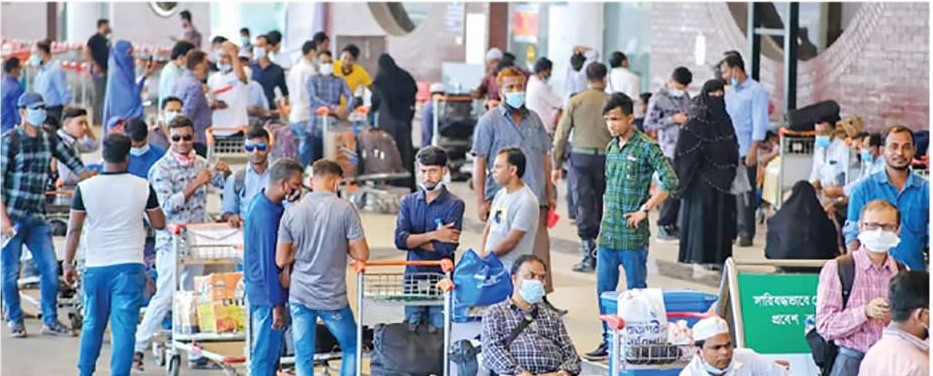
Imagine a Bangladeshi worker, far from home under a harsh sun, toiling day after day. The sweat of their labor and the challenges they endure abroad are not confined to their personal strug gle-they return home as remittances that fuel the dreams of their families.
With this money, a rural home may be built, a child's school books purchased, Ing licenses, managing the Wage Earners Welfare Fund, and signing international agreements. Currently, 29 labor welfare wings in 27 countries provide crucial support, protection, and assistance in remittance flows.
Under the ministry, the Bureau of Manpower Employment & Training (BMET) manages registration, data, and fingerprint smart cards to ensure legal migration. It offers technical training in fields such as construction, electrical work, and welding, equipping workers with skills needed in foreign labor mar-kets. BMET also assists in repatriating the bodies of deceased workers, provid ing compensation, scholarships, and financial aid. With demo offices in 64 districts, BMET offers digital services to simplify access for workers.
The Wage Earners' Welfare Board (WEWB) plays another important role.
leaving rural families, women, and the elderly dependent on informal-and often inaccurate-sources. Access to serv-Ices requires multiple documents, online registration, and visits to offices, which are time-consuming, costly, and discouraging.
While many services are digitalized, a large number of people do not have smartphones or internet access, and women often lack the necessary digital literacy. The geographical distance of Institutions from villages increases travel costs, and local service points are few, poorly staffed, and poorly coordinated. Informal intermediaries sometimes hide information or charge extra fees, further reducing trust in government services. Socio-cultural factors, such as limited mobility and decision-making power of women, also hinder access, and past experiences with delays, corruption, or denial of service have created skepti-
or higher education for a sibling made possible. The contributions of migrant workers are not merely personal suc-cesses; they are critical to the country's economy, accounting for five to six per-cent of GDP and significantly boosting foreign exchange reserves.
ave we Yet, the question arises: have reciprocated adequately for these con-tributions? Has the government ensured proper services for migrant workers ckers and their families? The answer is complex. While numerous initiatives exist, they often remain inaccessible or ineffective for many expatriates. Lets discuss gov-ernment efforts and the hurdles that limit their effectiveness.
The Ministry of Expatriates' Welfare & Overseas Employment, established in 2001, is the central institution responsi-ble for migrant workers. Its objectives are clear to ensure safe migration, pro-tect workers' rights, provide welfare, and foster a skilled workforce. The ministry focuses on training aligned with global labor market demands, reducing unem ployment, and safeguarding workers abroad. Its activities include expatriate welfare fare programs, labor market expan-sion, skill development, issuing recruit-
providing membership cards, pre-departure orientations, airport welfare desks, death and illness support, schol arships, legal assistance, reintegration schemes, and insurance benefits. These programs aim to create a sense of secu-rity for expatriates and their families. Bangladesh Overseas Employment & Services Limited (BOESL), the state-owned recruitment agency established in 1984, sends workers abroad at afford-able costs to countries such as Jordan, Malaysia, and South Korea. It ensures transparent, training-based, and online accessible immigration processes, aim-Ing for safe migration and positioning migran Bangladesh as a source of quality labor. Probashi Kalyan Bank (PKB), founded in 2011. provides low-interest loans. including immigration loans, rehabilita tion loans, and Bangabandhu Immigrant Large Family Loans, support ing entrepreneurial activities of migrant workers. With 120 branches across the country, PKB also offers online services.
Despite these efforts, many expatri-ates and their families face significant barriers in accessing services. Many are unaware of BMET PKB, BOESL, or WEWB services. Information is often city-centric and in complex language,
cism. Finally, some services require for-mal documents or qualifications that not all expatriates or families possess.
Government Initiatives for migrant workers are promising, but unless these barriers are addressed, services cannot reach their full potential. Policymakers must ensure that services are accessible at the grassroots level, giving due respect to the contributions of expatri ates. Doing so strengthens families, communities, and the national economy alike.
With a new government set to form after the upcoming elections in February, we hope and look forward to a leadership that will prioritize the welfare of migrants and their left-behind family members, ensuring these critical servic-es are expanded and effectively imple-mented. Looking ahead, innovative approaches are needed to make services more accessible to rural populations, women, and the elderly, while empow empow ering migrant workers to better under-stand their rights and available support.
The writer is a development professional,
educator, and researcher
