How drone technology can reshape our agriculture
MD Noor Hamza Peash [Published : Observer, 22 December, 2025]
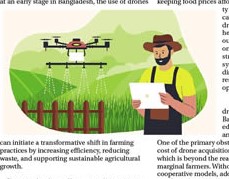
Bangladesh is an agricultural country and agriculture continues to play a decisive role in ensuring food security, employment, and economic stability. With a rapidly growing population and decreasing cultivable land, increasing agricultural productivity has become an unavoidable necessity. Traditional farming methods alone are no longer sufficient to meet rising food demand. In this context, the integration of modern technology into agriculture is not a luxury but a necessity. Among emerging technologies, drone-based agriculture holds particular promise. Though still at an early stage in Bangladesh, the use of drones can initiate a transformative shift in farming practices by increasing efficiency, reducing waste, and supporting sustainable agricultural growth.
Drone technology offers a new dimension to agricultural monitoring and management. Equipped with high-resolution cameras and advanced sensors, drones allow farmers to observe crop conditions with far greater accuracy than manual inspection. They can detect early signs of disease, pest infestation, nutrient deficiencies, and uneven crop growth across large fields within a short time. This real-time data enables farmers to take timely corrective measures, preventing large-scale crop losses. Such early intervention is especially important in a country like Bangladesh, where climate variability and sudden pest outbreaks often threaten harvests and farmer livelihoods.
Another major advantage of drone use in agriculture lies in precision spraying of fertilizers and pesticides. Conventional spraying methods often result in uneven application, excessive chemical use, and significant environmental damage. Drones, however, can apply inputs in a targeted and controlled manner, ensuring that only the required amount reaches the affected areas. This precision reduces chemical runoff into water bodies, lowers soil contamination, and minimizes health risks for farmers. Moreover, efficient chemical use improves crop quality and supports environmentally responsible farming, aligning agricultural productivity with ecological sustainability.
Increased efficiency through drone use ultimately translates into higher crop yields and improved farm profitability. Accurate monitoring, timely interventions, precise input application, and optimized irrigation collectively enhance productivity. Reduced waste and lower input costs further improve profit margins. For a country striving to ensure food security while keeping food prices affordable, these productivity gains are highly significant. If adopted widely, drone technology could help stabilize agricultural output, reduce dependency on food imports, and strengthen national food systems, contributing directly to economic resilience and rural development.
Despite its potential, drone-based agriculture in Bangladesh remains limited due to several structural and practical challenges. One of the primary obstacles is the high initial cost of drone acquisition and maintenance, which is beyond the reach of most small and marginal farmers. Without financial support or cooperative models, adoption remains restricted to a few pilot initiatives. Additionally, the absence of local manufacturing and reliance on imported equipment further increase costs, making large-scale adoption difficult in the current economic environment.
The adoption of drone technology also opens new opportunities for youth employment and entrepreneurship in rural areas. Trained drone operators, data analysts, and service providers can offer drone-based solutions to farming communities. This creates a new ecosystem around agricultural technology, attracting educated youth back to rural economies. Such engagement can reduce rural-urban migration, stimulate innovation, and modernize the image of agriculture as a technology-driven sector rather than a low-income occupation.
While drone agriculture in Bangladesh is still at a nascent stage, its potential impact is transformative. With appropriate investment, training, and policy support, drones can revolutionize farming practices by improving efficiency, sustainability, and profitability. Addressing existing challenges will require coordinated efforts from the government, private sector, and academic institutions. If these efforts are undertaken seriously, drone technology can become a cornerstone of modern agriculture in Bangladesh, ensuring food security and improving the quality of life for millions of farmers.