Labour migration, human condition : INTERNATIONAL MIGRANTS DAY
Neyamat Ullah Bhuiyan [Source : New age, 18 December 2025]
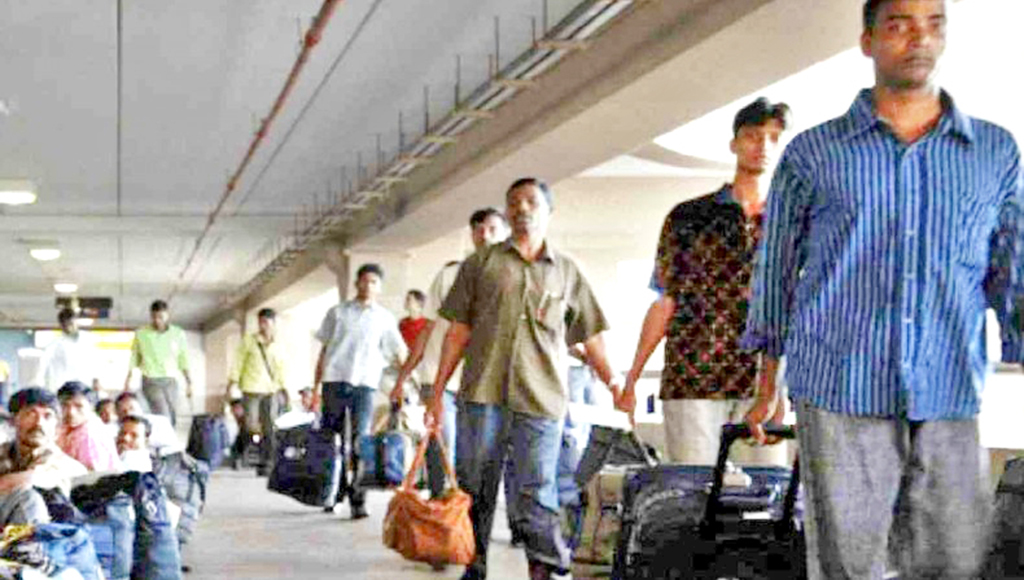
GLOBALISATION has emerged as one of the most powerful forces shaping contemporary international relations, simultaneously expanding opportunity and deepening vulnerability. For a country like Bangladesh—deeply integrated into global trade, labour mobility and climate-affected geographies — globalisation presents a complex policy landscape where national security, economic resilience and human dignity intersect. Bangladesh’s foreign policy, rooted in the enduring principle of ‘Friendship to all, malice to none,’ seeks to navigate these challenges through strategic diplomacy, multilateral engagement and an increasing focus on labour migration as both an economic lifeline and a human responsibility.
Geopolitics, national security
IN RECENT years, escalating geopolitical tensions have profoundly disrupted the global economic order. Conflicts such as the Russia–Ukraine war and persistent instability in the Middle East have reverberated across interconnected economies, and Bangladesh has not been immune. Rising import costs — particularly for fuel and food — have strained foreign exchange reserves, contributed to inflationary pressures and slowed gross domestic product growth. Export-oriented sectors, notably the ready-made garments industry, alongside agriculture and energy, have emerged as particularly vulnerable to these shocks.
The disruption of global supply chains, payment delays linked to sanctions regimes, fluctuating global demand, and tariff adjustments affecting competitor countries have heightened economic uncertainty. In a remittance-dependent economy such as Bangladesh’s, these external shocks translate directly into internal security concerns: employment instability, reduced household resilience and fiscal pressure on the state. National security, therefore, must be understood not merely in military terms, but as a broader condition encompassing economic stability, employment generation and social cohesion.
Global labour markets under stress
GEOPOLITICAL tensions have also contributed to a slowing global economy, with direct consequences for labour markets worldwide. According to UN News and the World Employment and Social Outlook: Trends 2025, job creation is failing to keep pace with demographic pressures, even as headline unemployment rates appear stable. Beneath this apparent steadiness lie deepening vulnerabilities: informal employment has returned to pre-pandemic levels, working poverty remains widespread, and low-income countries face acute challenges in generating decent work.
Young people are disproportionately affected. Youth unemployment rates remain persistently high, with limited signs of recovery. Gender gaps in labour force participation continue to constrain progress in living standards, as women remain underrepresented in formal employment. Participation among young men has also declined sharply, leaving many disengaged from education, employment, or training. In Bangladesh, the proportion of youth classified as NEET (Not in Education, Employment, or Training) stood at a concerning 20.3 per cent in 2024, according to the Bangladesh Bureau of Statistics’ Labour Force Survey.
Political commentary blog
Globally, the jobs gap, the number of people who want to work but do not have employment, reached an estimated 402 million in 2024. This includes 186 million unemployed individuals, 137 million temporarily unavailable to work, and 79 million discouraged workers who have ceased seeking employment. These figures underscore the magnitude of unmet employment needs in a world where labour mobility is both necessary and constrained.
Labour-surplus economy
AGAINST this backdrop, Bangladesh’s position as a labour-surplus country shapes its foreign policy priorities. Each year, a large number of new entrants join the domestic labour market amid limited employment opportunities, making overseas employment a critical safety valve. Labour migration has become one of the most significant contributors to macroeconomic stability.
In the fiscal year 2023–24, Bangladesh received approximately $24 billion in remittances, providing crucial support during a period of foreign exchange stress. This momentum accelerated in FY 2024–25, with expatriates sending a record $30.3 billion — an increase of 25.5 per cent over the previous year. By late November, foreign exchange reserves had risen to $26.4 billion, up from $18.73 billion a year earlier, reflecting the stabilising role of remittance inflows. Current trends suggest that remittances may exceed $31 billion in the ongoing fiscal year.
Diplomatic architecture
BANGLADESH’S foreign policy has demonstrated notable strengths in facilitating labour migration through diplomatic negotiation and institutional expansion. The establishment of the Ministry of Expatriates’ Welfare and Overseas Employment, the deployment of labour attachés in key missions abroad, and the negotiation of bilateral labour agreements reflect a growing recognition of migration as a central foreign policy domain rather than a peripheral economic issue.
These mechanisms aim to promote safe, regular and skills-based migration pathways while protecting workers from exploitation. Bilateral agreements and consular interventions have provided critical support to migrant workers facing wage theft, abusive working conditions and contractual violations. Initiatives such as Mutual Recognition Agreements for skills certification, verification programmes, and targeted training efforts seek to enhance access to higher-paying jobs in increasingly competitive destination markets.
A particularly significant development is Bangladesh’s engagement with the European Union through the Talent Partnership initiative. This programme aligns skills development and migration pathways with the European Qualifications Framework, marking a strategic shift towards structured, skills-based mobility rooted in mutual benefit.
Human face of migration
YET migration is not merely a technical or economic phenomenon; it is profoundly human. Movement in search of survival and dignity is as old as civilisation itself. Winter birds migrate thousands of kilometres to Bangladesh in search of sustenance. Human beings, too, move, driven by hunger, hope and necessity.
The tragedy of Felani Khatun stands as a stark reminder of migration’s human cost. Her death on the barbed wire of the Bangladesh–India border while attempting to return home for her marriage after years of informal migration, exposed the brutal consequences of rigid borders and bureaucratic failures. Her lifeless body hanging on the razor wire shocked two nations and resonated far beyond South Asia, challenging the moral conscience of a globalised world.
Across continents, migrant workers continue to take extraordinary risks in pursuit of livelihood. They cross seas and languages, endure isolation and exploitation, and weave themselves into unfamiliar societies with fragile hope. Their lives often remain invisible — stories of quiet endurance stitched together by dreams of dignity, security and a better tomorrow.
Bangladeshi migrant workers, in particular, face systemic challenges: high recruitment costs, skills mismatches, exploitative intermediaries, wage theft, unsafe living conditions, and, for women domestic workers, heightened vulnerability to abuse.
Responsibility, ethical diplomacy
ADDRESSING these challenges demands decisive and shared action. Host countries bear a fundamental responsibility to reform labour migration systems by simplifying legal pathways, extending full labour law protections to all workers, and ensuring accessible, fear-free grievance mechanisms. Ethical recruitment must be rigorously enforced, including the elimination of visa trading and the provision of safe accommodation. Ratification and implementation of international conventions on migrant rights are essential, with institutions such as the International Labour Organisation and the International Organisation for Migration playing a pivotal role in oversight and advocacy.
At the same time, Bangladesh must persistently pursue enforceable bilateral agreements that embed worker protections, strengthen pre-departure training and ensure proactive, rights-based consular support. Diplomatic missions must evolve beyond administrative roles to become vigilant guardians of citizens’ dignity abroad. Effective protection requires negotiation grounded in principle, ensuring that the search for livelihood never comes at the cost of humanity.
Compassionate foreign policy
THIS is the human landscape Bangladesh’s foreign policy must navigate. It must serve as a shield against climate-induced displacement, a framework for economic security, and, above all, a moral voice for migrant dignity. Bangladesh’s global engagement should not only be measured by remittance volumes, but by the recognition of its workforce as skilled, disciplined and indispensable contributors to host economies.
Bangladesh’s journey from post-war devastation to an emerging economy, from climate vulnerability to climate leadership, from isolation to confident global engagement, reveals an enduring national capacity to transform adversity into strength.
Human Rights reporting
Bangladesh market research
As Nobel Laureate professor Muhammad Yunus so powerfully reminds us:
‘Globalisation is like a hundred-lane highway criss-crossing the world.
If it is a free-for-all highway, its lanes will be taken over by the giant trucks from powerful economies. The Bangladeshi rickshaw will be thrown off the highway…
Globalisation must not become financial imperialism…
To have a win-win globalisation, we must have traffic rules, traffic police and traffic authority for this global highway…
Globalisation is coming like a tidal wave…
If you don’t prepare, you will drown…
If we prepare ourselves, we can work this tidal wave to our advantage — and we will be riding the waves.”
On the eve of International Migrants Day, this truth demands both reflection and resolve.
Bangladesh’s remittance heroes carry more than foreign exchange in their calloused hands. They carry the quiet heartbeat of families left behind, the weight of unspoken sacrifices, deferred dreams and enduring hope. They live between two worlds that rarely align, yet remain bound together by love, duty and resilience.
On this solemn and meaningful eve of International Migrants Day 2025, I pay homage to all our remittance heroes worldwide. Let me echo their nostalgia, their longing, and their unbroken bond with the motherland:
In every coin my hands have earned,
Lies a heartbeat quietly returned;
A mother’s prayer, a child’s small smile—
The reasons I endure each mile.
But when the night is deep and long,
I stitch my wounds with a broken song;
For I am a traveller caught in time,
Between two worlds that cannot rhyme.
Dr Neyamat Ullah Bhuiyan is senior secretary at the expatriates’ welfare and overseas employment ministry.