Unchecked violence casts a shadow on our economy
Fahmida Khatun [Source: The daily star, Dec 23, 2025]
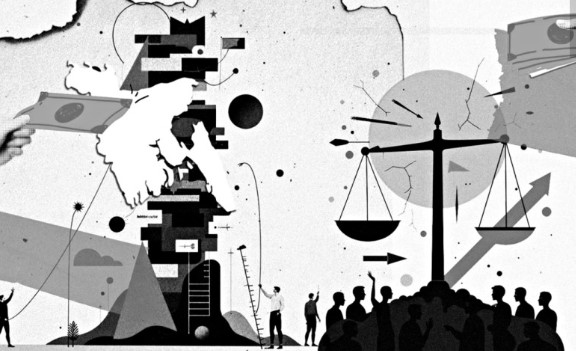
The recent wave of violence has revealed a deeply worrying trend in public life. Following the announcement of the 2026 national election by the Election Commission of Bangladesh, a young political leader, Sharif Osman Hadi, was shot in broad daylight on December 12 by miscreants. Six days later, he succumbed to the bullet injuries while undergoing treatment in Singapore. The killing of Hadi sends a clear message that speaking differently has become dangerous. This is not confined to politics. Mob attacks on two prominent newspapers and two cultural institutions, and the lynching of a minority citizen in public, are examples of how the country's atmosphere has been marked by violence and fear.
The attacks on The Daily Star and Prothom Alo are not just against their infrastructure. They are attacks on the idea that citizens have the right to know, question, and disagree. The free press holds up a mirror to society. When that mirror is smashed, those in power go unchallenged, and falsehoods spread easily. The assault on cultural institutions such as Chhayanaut and Udichi is equally alarming. These spaces keep alive values of tolerance, human dignity, and progressive thinking. Songs, poetry, and art shape our conscience. That is why they are often targeted first. The killing of a garment factory worker, Dipu Chandra Das—after he was beaten and his body was set on fire in Bhaluka, Mymensingh, allegedly by his co-workers and a mob falsely accusing him of hurting religious sentiments—is another example of intolerance when people took the law into their hands.
Together, these incidents portray to the world that intolerance is growing and public protection is weakening. A society that silences its voices, crushes its culture, and fears difference may still function, but it slowly loses its humanity, confidence, and hope for a better future.
These attacks took place while a functioning government was in place in Bangladesh. This realisation has shaken the conscience of peace-loving and progressive people, as many see these incidents as signs of a deeper crisis of values and erosion of confidence that now affects politics, governance, and the economy of the country.
The central issue, therefore, is the response to violence. In this regard, the government's performance has been hesitant and insufficient. Statements have been issued, assurances have been made, yet tangible outcomes remain scarce. The lack of visible progress in arresting Osman Hadi's killers has contributed to perceptions of institutional inertia. Since Bangladesh has functioning institutions, experienced administrators, and established law enforcement agencies, the challenge, then, is not technical ability but political will and clarity of purpose.
Public anxiety in Bangladesh today is not confined to politics alone. It is deeply rooted in everyday economic hardship. For millions of families, the real struggle is not about who holds power but about how to survive rising prices and shrinking opportunities. Food inflation, although lower than its peak, still bites hard for low- and middle-income households. Rice, edible oil, vegetables, transport costs, house rent, education fees, and healthcare expenses consume an ever-larger share of household income. For wage earners and small traders whose incomes have not kept pace with prices, life feels increasingly fragile.
Although average inflation has eased from 11.38 percent in November 2024 to 8.29 percent in November 2025, prices of essential goods remain high relative to income. For many, daily life has not become easier despite official signs of improvement, as wages have not increased. Wage growth remained stagnant at 8.04 percent in November 2025, down from 8.1 percent in November 2024, exerting downward pressure on household purchasing power.
Employment conditions are worrying. Formal job creation has slowed, while informal and short-term work has expanded. Many firms are avoiding permanent hiring, and underemployment is widespread. More than 20 percent of youth aged 15-29 are not in education, employment, or training (NEET), revealing deep labour-market stress. Young people entering the labour market face increasing difficulty finding stable and decent jobs, which contributes to frustration and social tension.
Private investment is weak. Private-sector credit growth fell to a record low of 6.23 percent in October 2025, reflecting persistent investment weakness. Domestic investors are delaying expansion plans, focusing on survival rather than growth amid a high cost of doing business and uncertainty. Foreign direct investment remains modest at less than one percent of gross domestic product, with new and existing investors cautious about investing. This is a major concern, as Bangladesh needs investment to diversify its economy and create higher-quality employment.
Although Bangladesh is widely recognised for its economic resilience and development achievements, images of mob violence and uncertainty over governance raise concerns among international partners and investors. In an interconnected world, political stability is inseparable from economic credibility. How Bangladesh navigates this moment will shape perceptions in the months ahead.
The way forward must therefore be grounded in both political responsibility and economic prudence. What is at stake now is public confidence and safety. Citizens want to feel that the state stands firmly on their side, that their safety matters, that laws apply equally, and that no one is beyond accountability. As the nation awaits a democratic transition through an election on February 12, 2026, the immediate priority of the interim government must be to restore law and order to protect citizens.
Dr Fahmida Khatun is executive director at the Centre for Policy Dialogue.
Views expressed in this article are the author's own.